
Arthur Lee and the American Dream
In 1931, Mr. Arthur Lee was working in Minneapolis as a postal worker. He had served abroad during World War I and was working to support his wife Edith and their young daughter, Mary.
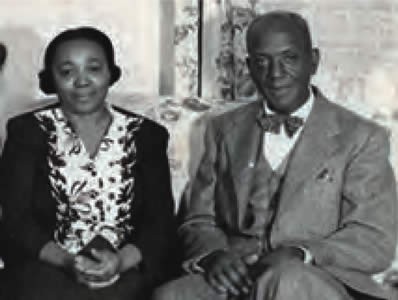
It was a tough time to raise a family; the Great Depression had left 4 million Americans unemployed, a number that would peak in 1933 between 12-15 million. Lee was fortunate to have a job as unemployment disproportionately affected Black Americans. Even more incredibly, Lee was ready to realize the American dream and buy a house.
The modest white house was located in the majority white Eugene Field Neighborhood of south Minneapolis. The neighborhood’s racial makeup was no accident. Racial segregation was not relegated to the South; it was rampant in Minnesota, perpetuated through redlining, racial covenants, and violence.
Methods of Segregation
Redlining was a practice designed to segregate housing opportunities based on race. Maps were color-coded to designate which areas were safe to insure mortgages and which weren’t. Black communities and nearby areas were coded red to indicate that mortgages would not be insured for these areas.
In addition, to promote the creation of more housing, the federal government subsidized developers who were mass-producing large subdivisions for white buyers and renters. To qualify for government subsidies, developers could not sell or rent their properties to Black Americans. This was further enforced by the use of racial covenants. These were provisions that prevented Black homebuyers from purchasing certain homes based on race and prohibited white homeowners from selling or renting to Black people. These covenants were outlawed by the Fair Housing Act of 1968, but can still be seen on property records today.
A Gentleman’s Agreement
In this case, the Eugene Field Neighborhood Association had made what they called “a gentleman’s agreement” not to sell or rent their properties to non-Whites.

The grass roots racism worked, making the neighborhood around 46th St. and Columbus Ave. entirely white. That is, until one homeowner diverged from their neighbors. This person owned the modest white house at 4600 Columbus Ave. and sold it to the Lee family for $4,700. (approx. $100,221 today).
The neighbor’s motivations for selling their home to a black family are unknown, other than resentment over an “unsettled grudge.”
Whatever the reason, the Lees moved into their new home in early July of 1931 much to the astonishment of their neighbors.
Shortly after the Lees moved in, the Neighborhood Association formed a special committee to figure out what to do about their new neighbors. The committee raised and offered the Lees $5,000 if they would leave. Mr. Lee, a shrewd man, countered with $7,500. Negotiations halted.
When bribery didn’t work, the neighbors resorted to a tried and true strategy- violence and harassment.
A Mob Gathers
Within a week, the Lee’s home was bombarded by neighbors shouting insults, threatening violence, and throwing stones and dousing the house in black paint. By July 11th, the mob had reached 150 people with the violence showing no signs of abating.
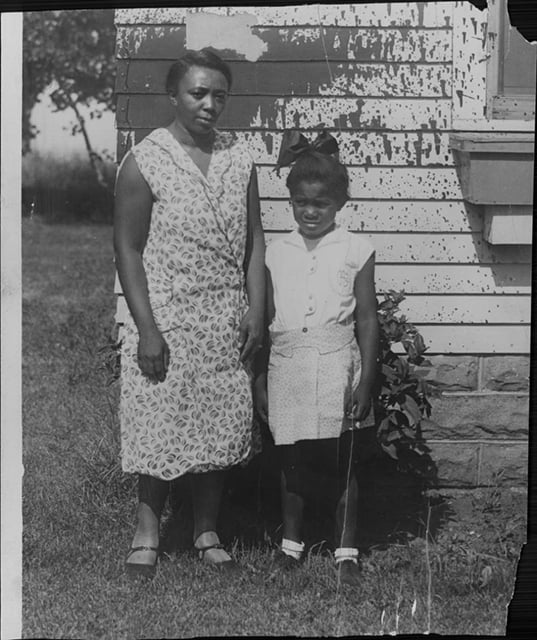
The Lee family kept the lights off and stayed away from the windows to protect themselves from the mob, which grew into the thousands. As the Minneapolis Tribune published on July 15th, 1931, “The Lee family kept their home in complete darkness. Whenever they appeared, outside or on the porch, the crowd lifted up its voice in threats and denunciations.”
The front yard was now littered with garbage, signs bearing racial slurs, and human excrement. Temperatures were reaching 100 degrees, exacerbating the odors.
The mob became so large that refreshment wagons began parking nearby to sell beverages to the mob.
Finally, the local police got involved. Captain A.C. Jensen arrived at Columbus Avenue and, on July 12th, threatened to arrest people for unlawfully gathering, though no arrests were made. He was able to calm the crowd a bit by suggesting they meet with the mayor and a committee of black leaders to seek a solution.
Then Mayor of Minneapolis, William A. Anderson, refused to intervene. He claimed that the situation was a neighborhood dispute and not under his authority and that the growing mob did not fall under his responsibility.
Finally, the Minneapolis Tribune published a front-page story on the event, titled “Home Stoned in Race Row.”
In the article, Lee was quoted as saying, “Nobody asked me to move out when I was in France fighting in mud and water for this country. I came out here to make this house my home. I have a right to establish a home.”
The article further stated “Despite the best efforts of the police, stones continued to be pelted at the house, usually by persons at the rear of the crowd, out of sight of the patrolmen.”
The article brought with it more attention and larger crowds until police had to cordon off the house and ensure the streets were not blocked by crowds.
No Intention of Moving
The Lees had retained an attorney who advised the family to leave. Wanting to fight for their right to live in peace in the home they bought, The Lees fired their attorney, instead hiring Lena Olive Smith, a lawyer and the president of the local NAACP.
Unlike their previous attorney, Smith was up for a challenge and ready to fight back.
Lena’s first move was to publish a statement in the papers, stating “[Mr. Lee] has no intention of moving now or later, even after we are assured the feeling in the district has subsided.”
Smith had earned her law degree from Northwestern College (now Mitchell Hamline School of Law) in 1921, becoming the first Black woman in Minnesota to do so.

Active in the community, Smith would eventually become the local National Association for the Advancement of Colored People (NAACP) chapter’s president from 1930-1939.
It was through the NAACP that she met the Lee family, who were members. Upon learning about what the family was contending with and their previous attorney’s retreat strategy, Smith was happy to help.
In an article about the event, attorney and law professor Ann Juergens wrote “Smith’s attitude toward the situation differed sharply from that of the Lees’ other advisors. She advised them not to move out in spite of the relief that a ‘settlement’ would bring. To Smith, the level of threatened violence only highlighted the importance of the principle at stake: that African-American people may live wherever European-American people live. Smith believe that ‘it would be unwise and unfair to this man to be forced to leave his home under the circumstances’ and that agreeing to move out ‘would have no effect other than to convince the mob that their action had been successful.’”
Smith held strong as tensions around the Lee home rose. She met with the police chief to encourage better protection of the Lees and even called on the Governor to summon the National Guard.
Police presence became constant around the Lee home and their daughter, Mary, had to be escorted to and from school.
In addition to the police, fellow veterans Lee had served with organized a group of armed guards to protect the home and family.
While helping with the family’s practical protection, Smith also worked on the public, making emphatic arguments in the press, asserting the Lee’s right to live in peace in their own home.
After a month, the mob began to disburse; after a year, police presence was no longer required.
The Lee family would eventually sell their house and move to the ethnically diverse Central neighborhood in Minneapolis, but this wasn’t until late 1933.
Arthur Lee’s Legacy
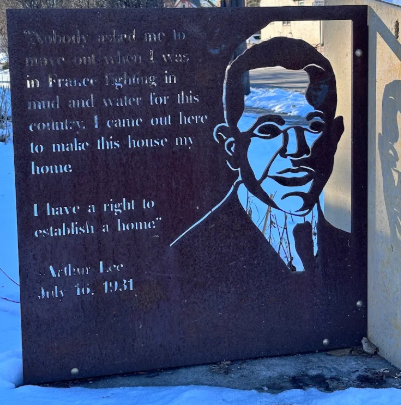
Today, the Lees’ former home at 4600 Columbus Avenue South in Minneapolis still stands, looking much as it did in 1931, minus the splattering of black paint. In 2014, the Arthur and Edith Lee House was added to the National Register of Historic Places. On the corner of the lot sits a metal sign, depicting Arthur Lee, accompanied by his quote from the 1931 Minneapolis Tribune Article.
Unfortunately, the Lee family’s story is not unique; redlining, racial covenants, and violence were all used to prevent people of color from purchasing homes. Most of the strategies utilized were created and enforced by the federal government, creating widespread impact on non-white Americans.
While these policies are illegal today, we can still see their impact in how our housing, transportation, schools, and how our communities are built. It is up to all of us to be aware of our country’s housing history so we can work together to address the harm done and create a more equitable future for everyone.